
About this specimen
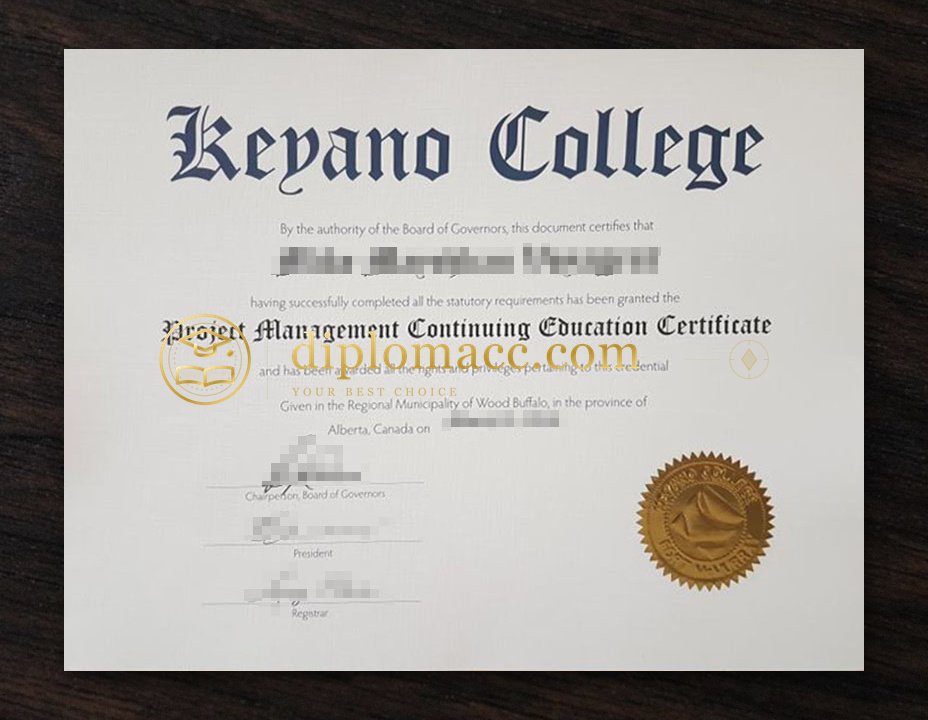
A Keyano College diploma derives its physical authority from a material vocabulary that is institutional rather than ornate. The college calls the document a parchment, and it is the College Seal applied to that parchment—not a dense heraldic programme—that carries the weight of authentication.#Keyano College dipolma Keyano College dgree Keyano College certificate.
The Parchment Substrate
Keyano issues its credentials on parchment stock, the baseline material for Canadian college diplomas and the substrate the institution itself uses as the document’s formal name. The college does not publish a fibre or weight specification, and the sheet’s exact dimensions are not documented in public sources. What is consistent is the logic of the material: a panel rather than a page, selected for stiffness and dimensional stability rather than ordinary printing, and heavy enough to hold a fixed impression without buckling at the edge. The surface carries a matte, lightly grained quality—a quiet ground established before the eye reaches the seal. The parchment is treated as controlled stock: the Office of the Registrar is the office that processes and issues it, and a replacement replicates the original except for a reprint date and any design changes made since the original issuance.https://diplomacc.com/samples/canada-diplomas
The College Seal as a Fixed Mark
The纹路 on a Keyano parchment are anchored in the College Seal. The seal is not a decorative flourish but a required authenticating mark: an official transcript “must bear the Registrar’s signature and College Seal,” and the same institutional logic governs the diploma. Keyano does not describe the seal’s physical mode in its public documentation—whether it is applied as a blind impression, a stamp, or a foil-lifted device—and the college’s policy language treats the seal as an institutional identifier rather than specifying its relief depth. In Canadian college practice, the seal functions as a fixed mark whose material presence distinguishes the parchment from a photocopy: a device registered by touch and angle of light before it is parsed as an image. The seal sits apart from the printed text, and its application is the final material condition of the document’s standing as a credential.
Surface Logic and the Security Repertoire
Keyano does not publish a feature-by-feature inventory of watermarks, guilloche linework, or microtext on its current parchment. The document sits within the documentary grammar of Canadian post-secondary credentials, which conventionally draws on watermarks formed during paper manufacture, guilloche designs whose interlocking geometry degrades under reproduction, and microtext embedded in borders. The parchment’s material identity is also shaped by the college’s visual language: Keyano’s refreshed brand identity is rooted in the Cree meaning of “Keyano”—sharing—and draws its palette from the northern Alberta landscape and the Athabasca River that runs through Fort McMurray. On the diploma, that identity does not announce itself through heavy foil or engraved ornament. It operates as a quietly layered surface: the grain of the parchment, the fixed presence of the College Seal, and the institutional colour temperature each produce a different response when the document is held, pressed, and angled to the light. The result is a sheet whose authority is registered in the body of the paper before a single word is read.