
About this specimen
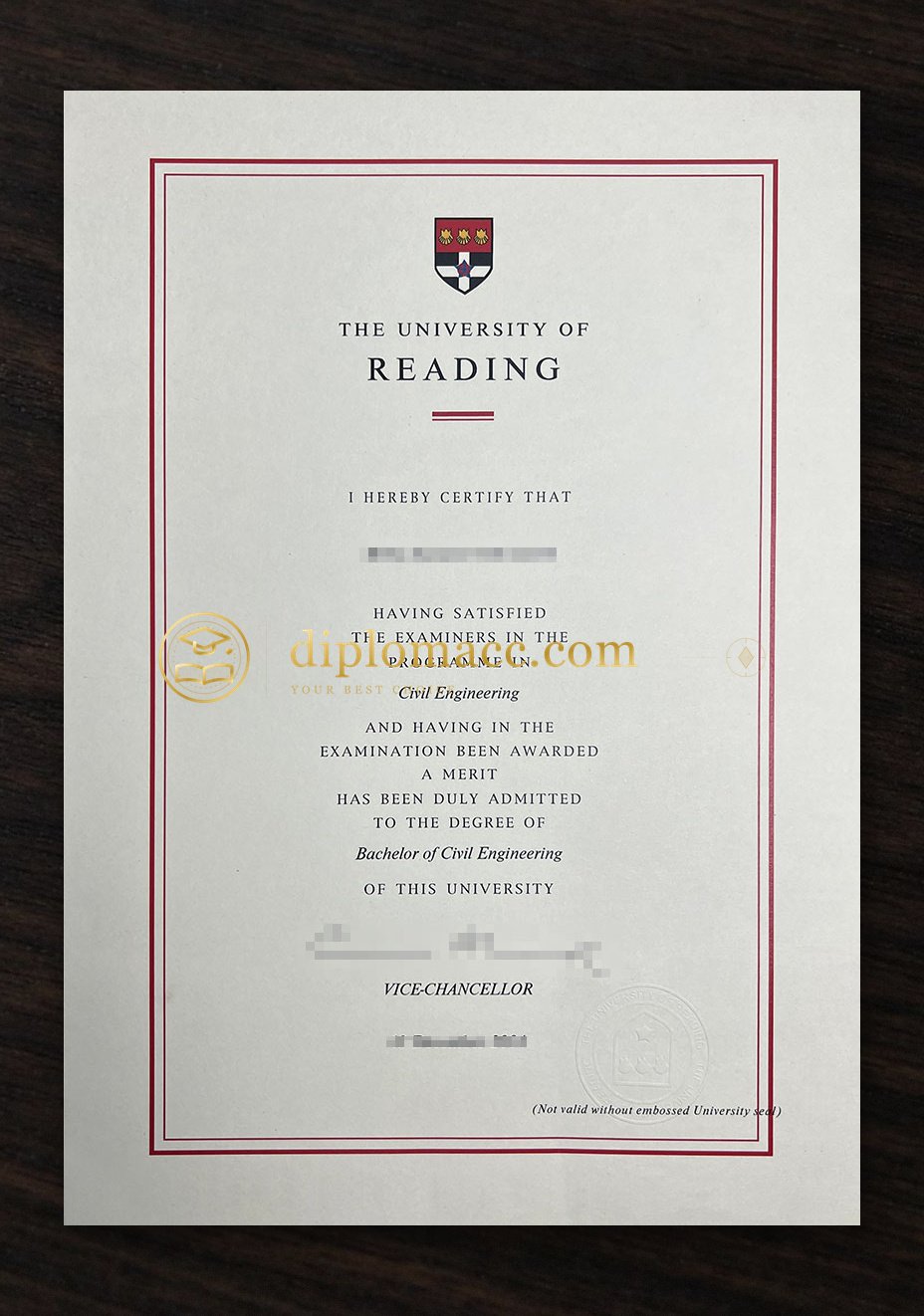
The physical substrate of a University of Reading diploma is not ordinary office cardstock but a purpose-built security paper whose characteristics are established at the fibre level before any printing occurs. High-security certificate papers of this class are typically produced on a cylinder mould machine, a papermaking technology that remains the benchmark for non-banknote security documents because it allows watermark formation to occur during sheet consolidation rather than being applied afterwards. The furnish, or stock, is engineered from a blend of wood pulp and, where enhanced durability and tactile quality are required, a proportion of cotton fibre; cotton lends the sheet a softer, more substantial handle and improves its long-term stability under varying humidity. The stock is also kept free of optical brightening agents so that the finished paper remains UV-dull, a baseline condition that allows subsequently applied fluorescent security features to be read unambiguously under ultraviolet light. Grammage for certificates of this type generally falls in the heavyweight range, often around 140 gsm or above, giving the document a rigidity that resists creasing and casual alteration.#University of Reading diploma,University of Reading degree,University of Reading certificate.
The watermark is the most fundamental and structurally embedded security element in the paper, formed while the sheet is still wet and cannot be separated from it without destroying the paper itself. In cylinder mould papermaking, a wire-mesh mould cover carrying the watermark design is submerged in a vat of dilute stock; as the mould rotates, water drains through the mesh, and fibres deposit preferentially in the recessed and raised areas of the cover, producing localised variations in sheet density that become visible as tonal differences when the paper is held to the light. This method is capable of producing multi-tonal watermarks rather than simple light-and-dark binary marks, which makes the Reading crest or institutional wordmark appear with a sculpted, three-dimensional quality under transmitted light. Because the watermark is a density variation within the fibre matrix, it cannot be reproduced by printing, scanning, or photocopying; any attempt to replicate it on a substitute sheet will either be absent or visibly superficial under raking light.
Beyond the watermark, the paper body carries covert and semi-covert features distributed through the furnish. Security fibres are introduced into the stock at a controlled rate during stock preparation so that they are dispersed throughout the thickness of the sheet rather than lying only on the surface. These fibres are typically visible in two modes: some are coloured and discernible in ordinary daylight, while others are colourless or lightly tinted under normal illumination and exhibit fluorescence only when exposed to long-wave ultraviolet light at 365 nm. In a diploma paper specification, the combination of daylight-visible fibres and UV-exclusive fibres creates a layered authentication path: a quick visual inspection reveals the first tier, while a UV lamp confirms the second. The paper may also receive a chemical sensitisation treatment that causes it to react visibly to attempts at erasure or solvent-based alteration, so that any effort to lift or modify printed information leaves a localised stain or discolouration rather than a clean surface.
The printing of the diploma introduces a separate set of physical and optical textures that are distinct from the paper’s internal features. The background and border are commonly built from guilloche patterns, which are generated by the repeated interference of two or more fine-line sinusoidal curves; the resulting epicycloid or rosette geometry is extremely difficult to redraw or digitally reconstruct without access to the originating mathematical parameters. These fine-line patterns may be executed in iridescent or optically variable ink, which shifts in apparent colour and intensity as the viewing angle changes, producing a metallic or pearlescent effect that is not achievable with standard process inks. Intaglio printing, where the image is cut into the plate and ink is transferred from the recesses under high pressure, can be used for the crest or other principal graphic elements to create a raised, tactile relief on the paper surface; this engraving depth is both a visual and a haptic feature, detectable by running a fingertip across the printed area. Microtext may be embedded within the guilloche border or along the inner edge of the frame, with character heights in the 200 to 300 micron range, so that the text is legible under magnification but degrades into a continuous line or a blurred texture when photocopied.
The seal or emblem on the diploma operates in a different register from the flat printing, relying on three-dimensional deformation of the paper rather than ink deposition. An embossed seal is produced by pressing the sheet between a male and a female die under controlled pressure, which compresses the fibres locally and creates a bas-relief impression that catches light from different directions; the crest or shield stands in relief while the surrounding field is recessed, and the effect is most clearly read when the document is tilted obliquely to a light source. This dry embossing is distinct from a printed seal because it has no colour layer to wear away or lift, and its topography is continuous with the paper itself. In some specifications, the embossed area may be combined with a registered UV feature or a fine-line intaglio element so that the physical relief and the printed image reinforce each other, requiring a counterfeiter to reproduce not only a graphic but also a precise mechanical deformation of the sheet. The cumulative effect of these processes is a document whose authenticity resides in the interaction of paper structure, internal fibre features, engraved and fine-line printing, and relief marking, each of which demands a different set of industrial capabilities and cannot be replicated by ordinary digital or office printing equipment.