
About this specimen
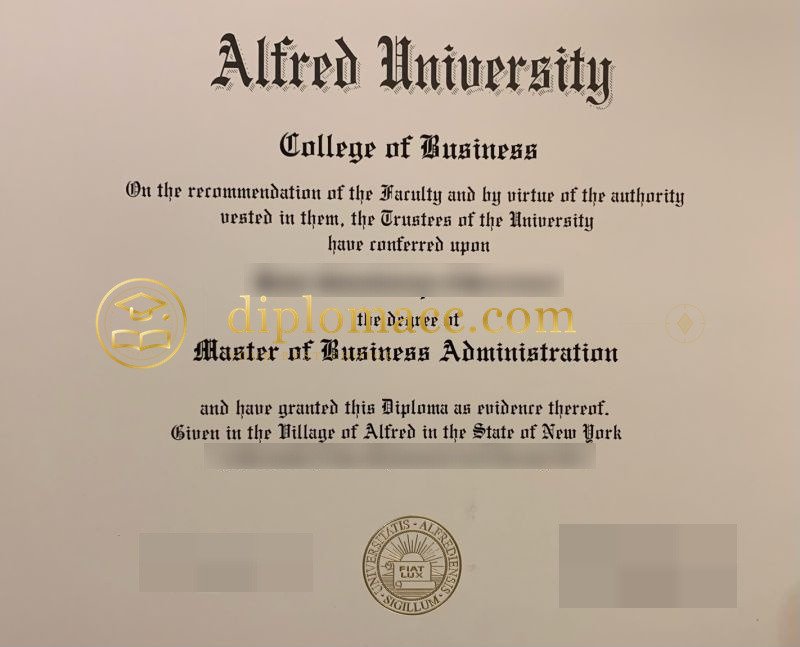
The physical format of an Alfred University diploma is established at 8 1/2 inches in height by 11 inches in width, a dimension that defines the usable field for the text block, the border, and the seal area. Within that format, the substrate is a security-grade paper rather than ordinary certificate stock, and its properties are fixed at the pulp stage before any printing occurs. Papers used for credentials of this class are commonly specified as a 28-pound white security stock, a weight that provides sufficient rigidity for handling while remaining compatible with the mechanical stresses of die-striking. The furnish is formulated without optical brightening agents so that the sheet remains optically dull under ultraviolet illumination, establishing a neutral baseline against which covert features embedded in the paper can be read without background interference. The fiber blend is selected for dimensional stability and for the capacity to accept a gold foil imprint without cracking at the impression zone.#Alfred University dipolma Alfred University degree Alfred University certificate.
The internal watermark is formed during sheet consolidation rather than applied as a surface image, which makes it inseparable from the fiber matrix of the sheet. On a paper machine equipped with a dandy roll, the watermark design is pressed into the wet fiber web, displacing fibers and creating localized density variations that read as a two-dimensional tonal image visible from either side of the sheet when held to transmitted light. Because the mark is a structural density variation within the paper itself, it cannot be reproduced by printing, scanning, or photocopying, and it remains embedded in the sheet without any surface layer that could be lifted or abraded. The watermark may be complemented by security fibers distributed through the furnish, including invisible fluorescent fibers that are embedded into the paper and viewable only under ultraviolet light, introducing a second substrate-level signal before any printed or mechanically applied feature is examined. The pulp may further contain chemical reagents responsive to known alteration agents, so that localized chemical attack produces a visible stain rather than a clean modification.
- Buy the latest Alfred University dipolma.
The printed surface of the diploma carries a separate layer of fine-line and micro-scale texture that operates independently of the paper’s internal watermark. Microtext may be embedded within the border or background at character heights below the resolution of the unaided eye, so that the lettering remains crisp under magnification but appears solid or jagged when a reproduction is attempted. The border may be composed of a high-resolution design of clear and unbroken fine lines that blur or become indistinct when photocopied, while a void pantograph feature in the underprint is formulated to produce a visible word or symbol through the act of copying itself. These surface features sit on the sheet rather than within it, yet they function as a complementary authentication layer by verifying the printing origination as distinct from the paper source.
The official seal on the Alfred University diploma is documented as an Alfred University Gold Foil, a construction that places its physical manifestation within a hot foil stamping tradition rather than a flat printing process. In foil stamping, a metallized foil carried on a carrier film is positioned over the paper, and a heated die bearing the seal design in relief is pressed against a matching counter-die; the heat and pressure release the foil from its carrier and bond it only in the area of die contact, while simultaneously compressing the paper fibers beneath the design into a bas-relief impression. The seal design itself may carry the university’s motto, Fiat Lux, and the layered elements of the institutional emblem each produce distinct depths of relief under the die, so that the finished seal reads as a topographic surface rather than a flat graphic. Because the foil is mechanically bonded under heat and pressure and the paper is deformed in the same operation, the seal combines two properties no ink-based process can reproduce: the angle-dependent reflectivity of the metallic layer and the tactile relief of the die impression.
The layered construction of the Alfred University diploma therefore depends on the interaction of substrate-level, surface-level, and mechanically formed features rather than on any single device. The security paper with its internal watermark, fluorescent fibers, and chemical sensitization establishes the sheet as a controlled material that reacts to alteration attempts; the microtext, fine-line border, and void pantograph establish the graphic as originating from a security printing environment and activate copy-detection signals under reproduction; and the gold foil die-struck seal introduces a metallic, three-dimensional element that cannot be lifted or transferred intact from one document to another. A photocopy or digital scan may capture the visible layout and the outline of the seal, but it will fail to reproduce the transmitted-light watermark, the ultraviolet behavior of the embedded fibers, the fine-line integrity of the border, and the reflective relief of the foil impression, leaving the physical sheet as the only carrier of the complete set of authenticating signals.